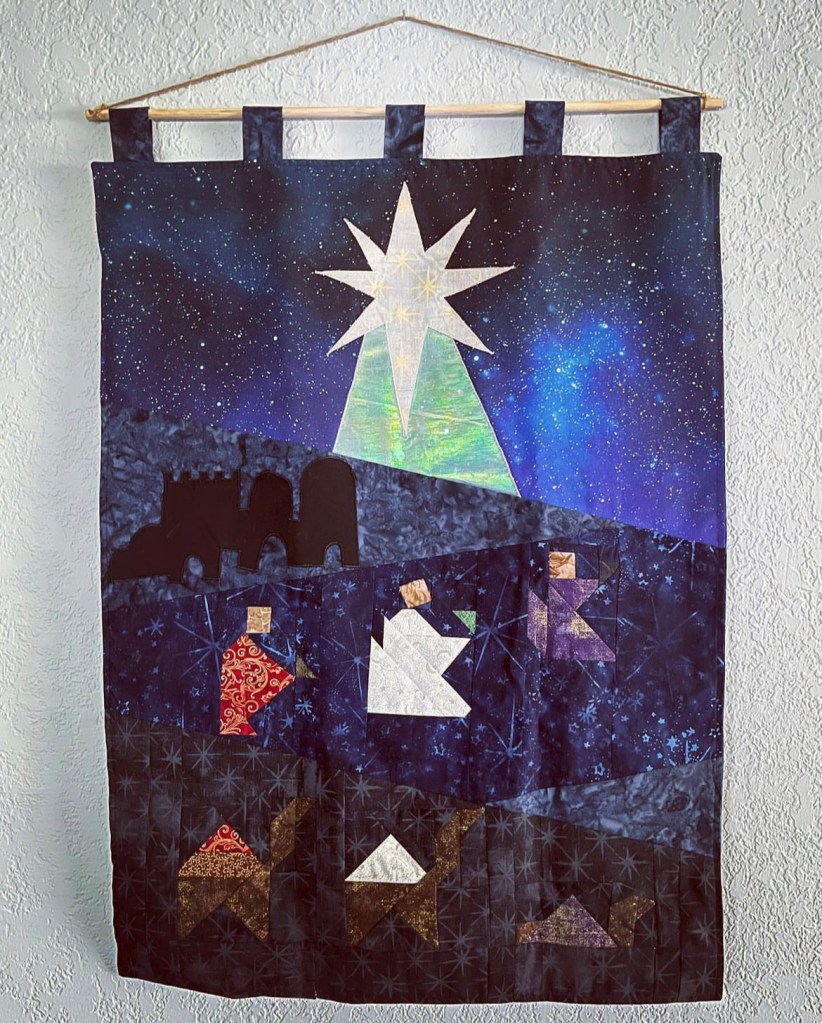
mosaic

In packing my life up to move across the country, I’ve been carefully considering the pieces of me that I most want to bring. I feel a lot like Nichole Nordeman’s song, The Unmaking, sorting through what stays and what should go. Space will be at a premium in my NYC apartment, so the list is short. As I wrap each item in paper and label it like a present to my future self, I think about how if I was the anthropologist version of a medical examiner and I autopsied my life up till now, these packages would tell my stories.

One of the first things I wrapped is a beautiful limited-run print of a painting by Chicago-based artist Tina Figarelli entitled In This Hallowed Place. Although, up until I double-checked today, I’ve been under the impression that it was simply called Grief. Whimsical and gothic, it features the artist sitting on a wood floor with her face in her hands beside a dead bird. The bird is the most colorful part of the piece, but in death the edges of it are starting to fade. Behind the artist and the bird is a piece of furniture, draped in a white cloth like a ghost. When I first saw it on Instagram a few years ago, I was immediately captivated by its storied emotion. It feels sacred and heart rending in a way that words cannot convey. I feel a kinship to this piece as if it sees and honors grief in a brutally honest and organic way.  

Similarly, I wrapped a framed postcard I bought at the St. Louis Art Museum last month. I was with a friend at the time, which adds to my love of it. I’ve noticed many of my most treasured possessions are special because of the people I was with when they came to me. On the postcard is a painting of St. Francis in a black monk’s hood, his head bowed reverently towards his hands which bear a skull, tucked almost in complete shadow. The shades of grey highlight the saint’s bowed head, then leads us to follow the saint’s gaze as he beholds death and mortality in his hands. There is grief here, too, but also a sort of sacred awe and wonder.

Another thing I wrapped up is a framed pressed leaf I once brought back from a hike with my mom and brother. I think it was Mother’s Day during one of the pandemic years and hiking in the woods was one of very few safe ways we could mark the occasion with a change of scenery from being home so much. I don’t even know offhand what kind of tree the leaf is from, but it’s bigger than my hand and even dried out it’s a lovely deep burnt orange – one of my favorite fall colors. I have pictures from that hike with me holding the leaf in my hand, a simple souvenir from a tenderly lovely day.

Then there’s the Ben Wildflower carved wood block print of a dove and a uterus, entitled Blessed Be the Fruit of Thy Womb. When I went to label the paper I wrapped it in, I intended to shorten it to Blessed Be the Fruit before I came to the conclusion that avoiding an awkward Handmaid’s Tale reference outweighed brevity in this case. I particularly love this print because it reminds me that there is a place for me in the work of alchemizing a soulless world into a sacred world. Having come from church spaces that taught that my gender as a woman dictated how I was allowed to show up in this world, I feel a sense of liberation in sacred art that honors the feminine qualities of the Divine.

There’s also the cyanotype of yarrow leaves one of my friends commissioned an artist to make for me. The deep blue from the chemical reaction is interrupted by the negative space from the imprint of the spiky leaves. In folklore, the yarrow plant symbolizes everlasting love. It is part of an herb wreathe tattoo I have where yarrow, sage (for protection), laurel (victory), and thyme (courage) encircle the birthdates of my Nana, mom, brother, as well as my own.

Here and there, as I’ve considered the things that mean the most to me, I’ve written on the backs where I was when I found them. The wooden sacred heart covered in miraculous medals I got in Santa Barbara while I stayed there for work; my mom had flown out to visit me and we were exploring an old mission when I bought it at the giftshop. On that same trip, we drove through the mountains to Solvang where I found a ceramic sign with my favorite benediction, the Numbers blessing: May the Lord bless you and keep you… Even the little things I like to think of as my crow shinies, mostly rocks and other small trinkets, I’ve been delighted to recall where they came to me. A labradorite palm stone from Puerto Rico. A tourmalated quartz point from Main Street St. Charles. Acorn caps scavenged at a park. A tiny metal icon of Mary Magdalene from Saint Meinrad Abbey. A little pennant that says You Are Magic from a friend. A mountain scene painted onto a tree slice made by another friend…

As this move has caught like wildfire from a distant idea to materializing in less than a month now, I’m trying to be mindful of my anxious brain. This practice of methodically going through my things, taking careful inventory and balancing it on a scale of utility and sentimentality, is helping me feel more steady in a choppy sea of nervous excitement. I’m both ecstatic and terrified, in varying measure at any given moment, as I look ahead to this next chapter. I’m learning that some things have to come to an end, something that as practiced procrastinator I’ve never been good at. As someone who is very true to my human nature in seeking stasis, I’ve never been good at dealing with change. I love routine and order. At the same time, I love the idea of the unknown, even though in practice it terrifies me. There’s a part of me that I’ve been glimpsing more and more since I made this decision that is yearning for the unknown. I was touched recently during a conversation with a friend where she observed that the self-awareness she’s seen me develop over the past few years she sees being a vital asset for me in this change. Not only is it an honor to be seen, it feels really good to actually see progress in the amount of self-reflection I’ve done so far in my 30s. I feel like I’ve been in a dreaming phase for so long and now it’s finally time for me to reach out and experience what I’ve been waiting and preparing for.

I don’t fully know what’s coming next for me. I have some general ideas, sure, but I have been practicing embracing mystery. So far this has looked like unfurling my fists around the idea of needing to plan everything. Jesus’ teaching about “Do not worry about tomorrow… for today has enough trouble of its own” has taken on new depths of meaning for me in this. I want to be careful not to be so focused on trying to plan too many steps down the road that I miss the voice of the longings within me reaching out. I want to explore and seek and be.

As I consider all these pieces of me, I think of them as little points of light that constellate the mosaic of who I am, suggesting that I am ever changing and evolving, gathering new experiences, remembering and learning along the way the Love that has always been with me.

The Gd of Everything

Hi, I’m Jan. I’m an aspirant for holy orders to the priesthood in the Episcopal church. Here I am writing my wondering over today’s lectionary readings. Peace be with you.

+

I love how in my faith tradition our lectionary leads us through our holy texts, holding them up and contemplating their meaning in community with one another. Over time, we return to the same stories. Each time we meet these stories, we might notice something different, because we are different each time we return to them, and there are other things that remain constant and eternal, just as the stardust of our being is constant and eternal.

Today’s passage from Acts (8:26-40) tells of the Ethiopian Eunuch reading the prophecies of Isaiah in his carriage on his way home from Jerusalem. Philip is led by the Spirit to meets this unnamed man on a desert road to Gaza. As the Reverend Mary Haggerty discussed in her sermon today at Holy Communion in University City, this man was a sexual anomaly from the order of the society of the time. He was an outsider, an other. And the words he read from Isaiah’s prophecy speaks of Gd’s embrace of the innocent others of society. Our Gd is the Gd of the margins, of the ones who don’t fit into the social and economic power structures of their time, of the dispossessed, overlooked, and underestimated.

I am intrigued by the Eunuch’s question to Philip, when asked if he understood what he was reading: Without someone to guide me, how could I?

I wonder if the Eunuch actually understood more than what he let on; perhaps he wanted to see what Philip knew of the prophecy. The way the Eunuch asks who the prophecy is referring to suggests he’s been evaluating the text for at least a little while. Or, perhaps it was in pouring over the words of the prophet that the Eunuch became so enthralled that when a stranger came running up to his carriage and asked him about what he was reading he was delighted in the opportunity to learn more.

At the center of today’s Acts passage is Isaiah’s prophecy of the suffering servant.

Like a sheep he was led to the slaughter,
and like a lamb silent before its shearer,
so he does not open his mouth.

In his humiliation justice was denied him.
Who can describe his generation?
For his life is taken away from the earth.

This prophecy is a heart-wrenching description of the Messiah, who Christians believe to be Jesus of Nazareth. To the people who first heard the prophet’s words and to all of us throughout time and place who have looked to these words, the Messiah is hope for resurrection and restoration, an end to violence and war. In the time of the Ethiopian Eunuch, a time of political upheaval and foreign occupation that harshly dictated societal norms and expectations of who was in and who was not, these words would have been as a cool drink of living water in a parched and barren desert.

It is on a desert road that Philip and the Eunuch speak and it is along that road that the Eunuch asks to be baptized. There is something so potent, something deep that calls to the depths of our humanity, in the character of Jesus, the humble suffering servant: Gd with us, enfleshed in our experience of life and death.

In the second lesson today, (1 John 4:7-21), John exhorts his beloved friends to love one another: Dear friends, if Gd loved us this way, we also ought to love each other. No one has ever seen Gd. If we love each other, Gd remains in us and his love is made perfect in us. This is how we know we remain in him and he remains in us, because he has given us a measure of his Spirit… We have known and have believed the love that Gd has for us.

I imagine these to have inspired Victor Hugo’s quote from Les Misérables: And remember the truth that once was spoken, to love another person is to see the face of Gd.

It is in loving one another – and that means everyone – that we see the face of Gd.

Gd, this mystery who is without form or substance, and yet is as close as our next breath, which Gd breathed into our lungs from the foundations of the earth and placed Gd’s name on our lips: Yahweh. Breathe in – Yah – breath out – weh.

In our Gospel lesson (John 15:1-8) Jesus describes himself with imagery of a gardener tenderly caring for his garden and the relationship of a plant with its vine and branches. This relationship is one of community, of connection and abiding and presence. When a branch is separated from the vine, it withers and dies. But when it is connected to the vine, it bears fruit. The branches stretch out as the roots reach deep, absorbing sunlight and water, reaching and anchoring. Plants have a fascinating kinship with their environment, including other plants. If a nutrient deficiency is detected in the environment, some plants produce and send the remedy to bring about balance which benefits everyone and everything. If a plant is threatened by illness or injury, its parts and others around it send extra nutrients to the impacted part, nurturing and restoring. We humans should look to our plant friends for their wisdom on how to live in community.

Because frankly, as a whole we humans are pretty lousy at harmony and balance. We let fear cloud how we see our fellow human beings. Today, fear is monetized. So many public figures and institutions uphold the view that the world is a dangerous and scary place, full of people who want nothing more than to cheat you and take you for all that you have. Conveniently, those same figures and institutions turn around and endorse hyper-militarization, which they essentially sell like water to a fish. This manipulation prevents us from living into our belovedness in community with one another. We don’t see Gd right in front of us, in the eyes of every human being.

It did not escape my notice this morning when I first read the Acts text that Philip was lead by the Spirit to go to the road from Jerusalem to Gaza. The same Gaza which today our American government is aiding and abetting Israel to ethnically cleanse under the guise of self-defense and claiming that it is somehow anti-semitic to oppose these atrocious actions. In the years after 9/11, there was a surge of hyper militarization that maintained public support for the War on Terror. I distinctly remember the absolute gem of a song from Toby Keith about putting a boot in an anatomically impossible place because “it’s the American way.” I do not claim to have the solution that so many have argued over for so long. I do know that it is fundamentally and at our deepest core contrary to the sacredness of creation when we murder our fellow image bearers. There is no atoning for this utter defilement of the human condition. As Jesus was a sheep lead to the slaughter and denied justice, so too the American people are loading the guns for those who are leading the people of Gaza to be denied the most basic justice of life.

In pouring over these texts by hearing them read and preached by one of my faith mothers I am struck by the rootedness of community and how we were made for it. We were not meant to be alone.

Fear separates and isolates. Fear expects punishment, as John wrote in today’s epistle. Fear metastasises and people die. Fear makes people turn the other way when glimmers of humanity break through the haze of propaganda.

Love made us and it is in love that we move and have our being. Perfect love casts out fear. Love bends low and looks us in the eye as we grieve the painful, tragic, and sinful things that hurt us.

Love tells us: I am here. You are not alone. I am the Gd of all things… of broken hearts, the gold of kintsugi beautifully binding broken pieces back together, of the cry of a red-tailed hawk as it soars high and the breath of the smallest mouse burrowed deep, of watering eyes and rivers of tears, of children preaching with their noise in hallowed places, of the steam that hovers over piping hot coffee presided over by old friends, of flower sellers on street corners, of rubble and those who walk from it and those left below, of cries for justice on campus lawns, of whispered prayers behind locked doors, of raising dry bones and calling for the downfall of empire, of pinecones and ash, mycelium and radical crazy mercy, of resurrection and life …

of everything.

An Uncertain Faith

Evangelicalism tried to baptize certainty, tried to make it sacred, tried to force us into a binary where doubt meant faithlessness and certainty mean faith. “Now faith is being sure of what we hope for and certain of what we do not see” (Hebrews 11:1), exhorts the author of Hebrews in a verse I have memorized from seeing it on a poster in a high school classroom. The NIV translation uses the word certain, and boy did we ever run with that. Meanwhile, the CEB version is phrased: “Faith is the reality of what we hope for, the proof of what we don’t see.” And the NRSV translation reads: “Now faith is the assurance of things hoped for, the conviction of things not seen.”

Here in just three translations, a key word that for much of my life was given as the benchmark for faith – certainty – is but one understanding of the original Greek text. The others, proof and conviction carry similar meanings, but I wonder at what we’ve lost in holding so tightly to just one version. Certainty, by definition, means known for sure, established beyond doubt. Meanwhile, proof means evidence or argument establishing or helping to establish a fact or the truth of statement. And conviction is a firmly held belief or opinion. Each of these meanings require some form of evidence predicating what is being described. Justifying, perhaps. By no means am I a Greek scholar, but I feel that I can intuit that there is more to this verse than simply admonishing people thousands of years after it was written to be absolutely and completely certain in their faith, or else they have none at all.

In each of the examples that Hebrews lists after describing faith, there is an unexpected ending, one that by human standards was anything but certain.

Abel offered to Gd a more acceptable sacrifice than Cain. The younger son was favored over the older, a theme we see repeat throughout the biblical narrative but would have been unheard of by the cultures surrounding these stories.

Enoch was taken so that he would not experience death. Another unexpected outcome; who thinks with any certainty that a human won’t one day, by one means or another, die?

 Noah was warned by Gd about events yet unseen, respected the warning, and built an ark to save his household. Surely the idea of a flood wiping out the earth was anything but a certainty to anyone, then or now.

And so on, we are given example after example of a humans interacting with Gd, and the expected is turned upside down and it is the unexpected that is raised up in the end.

There is a beautiful mystery at work here in this alchemy of contrary things.

Much like the idea of death being transformed into life.

Yet we see it, over and over again, and are promised it, over and over again still.

“Look, I am making all things new!” (Revelation 21:5)

Evangelicalism told me my questions meant doubt, that I should just “Be still” and believe (a shitty reference to Psalm 46:10). In that system, uncertainty threatened faith. It glorified certainty and vilified questions.

Why do I care about all this now? Nearly sixteen years since the beginning of my deconstruction, why do I still revert back to the things I was taught in my childhood and youth?

For one, because frankly I’m mad about it. I’m mad that I and so many like me were sold a counterfeit faith. We were told to follow the rules, stay in line, do what you’re told, and everything will turn out fine. So we did. We played by the rules. So much so that when life inevitably happened, we believed with such certainty that we were the problem. We simply weren’t enough.

The other is because of the ones who didn’t make it this far. The ones who were crushed, in body or in spirit; the ones who were crucified by a Church system that worshipped a crucified Gd.

Because the idea that to have faith you have to bury or apologetic-away your questions, that you have to be doubt-free, you have to be, above all things, certain of what we do not see – this idea is bad theology.

And bad theology kills.

I believe in a crucified and resurrected Gd, who sought out his understandably terrified friends and showed them his wounds. Who, when his friend Thomas wasn’t there to witness this and was understandably skeptical, our Gd sought him out too.

Certainty, at least in the way I was once taught, is a practice of individualism. If we are absolutely certain of everything, we don’t need anyone.

But our Gd is a Gd of relationship. Of community. Our Gd wrapped Gd’s starry self in human flesh, and came to us in the most vulnerable of forms. Our Gd lived amongst us, laughed and cried and taught and fed and ate and saw and forgave. Over and over and over again.

Maybe the point isn’t in being certain, but in letting go of certainty. Letting go of the constructs that our human minds can conceive of, of being open to mystery.

Lent is about Wilderness. Each Lent we read the story of Jesus being driven out into the wilderness, where he was utterly alone but for the cold night, the burning day, and the accuser – Satan – to tempt him. It was from that transformational experience that Jesus moved towards his ministry. Yet another unexpected outcome.

This Lent has me wondering about other sorts of Wilderness. There is all sorts of terrible things out there, sure, but what if transformation is part of it all?

We are transformed in the most unexpected places and in the most unexpected ways. None of that sounds like any sort of certainty to me.

Yesterday I took my 5 year old niece to the Botanical Gardens. I had been there a week ago on my own and was excited to see what a week’s worth of late February sunshine and rain could mean for the gardens; and I knew my niece would love the chance to run around and explore. We both delighted in seeing the green tips of the first buds peeking out of their brown beds. We imagined what it will look like a week or a month from now. At the water lily pond, brown squares floated in leaf-littered water, and we imagined the seeds sleeping under the surface of the dirt. Sleeping and dreaming and waiting.

Who can know the things the seeds do in the dark?

Science, of course, tells us of stratification and the beginnings of the plant life cycle and the dividing and growing that starts in the secret depths of the velvet darkness.

But to the naked eye, we pass by plots of dirt littered with leaves and the stalks of last season’s dead plants; we can’t see the genesis happening so close to us, yet worlds away. In tiny, unseen ways.

This is what I believe faith to be. It isn’t a faith I can define exactly. Like different seeds require different nutrients, different types of soils, different depths, different processes of cold and heat, so too, every human being is different. Our connection to the Divine around and within us is different. Our faiths are different. Uncertain, even. But still good.

I’m reminded of a quote from C.S. Lewis’ The Lion, the Witch, and the Wardrobe:

“Is he quite safe? I shall feel rather nervous about meeting a lion.”

“… Safe?” said Mr Beaver … “Who said anything about safe? Course he isn’t safe. But he’s good.”

With respect to the author, to suggest that Hebrews 1:11 engenders a harsh delineation of what is an isn’t faith gives no thought to context or the nuances of an ancient text translated from its original language. I believe the story in the margins and between the meanings of words, the spirit of these ancient words of hope and prophecy and life written and recorded by and to people moving through different times and places towards wholeness and safety and community – these are the places where seemingly contrary things are alchemized by the Living Gd, where dry bones are breathed over and into, where life springs from death.

Certainty is too small for this sort of thing.

show the way

One of my best friends, Kat, has been my sister since high school. We were raised in the same Evangelical Christian spaces and have walked very similar paths through deconstruction and reconstruction. One of the things we’ve shared over the years is a deep love for the somber reflection the season of Lent offers. We have a tradition of comparing notes on how we plan to observe the season each year. In sharing our plans, we often have found new ideas in each other’s ponderings and from that has sprung some of the richest experiences of faith.  

This year, while I was considering giving something up and adding a practice in its place, Kat told me about how the idea of giving something up is not serving her this year. So she went onto our St. Rachel Held Evans’ blog for some ideas and found a suggestion to connect with a saint during Lent by studying and praying for their intercessions. So Kat did some exploring and found herself drawn to St. Margaret of Antioch. When I asked what drew her to this particular saint, Kat told me about how she was disowned by her pagan priest father for converting to Christianity and she went off with her foster mother to keep sheep in peace. Meanwhile, the governor of the Roman Diocese of the East wanted to marry her and for her to renounce Christianity. When Margaret refused, she was tortured and fed to a dragon who swallowed her whole (big Jonah vibes). While in the dark belly, Margaret used a cross to irritate the dragon’s innards and she escaped. Thus she is traditionally depicted emerging from the dragon’s mouth. Kat reflected on how there was something powerful about a woman being swallowed by a dragon but never giving up, holding onto the cross in the belly of the beast; and how sometimes it feels like we’re in the dragon ourselves, and all we can do in the darkness is lean on that cross.

In hearing Kat share these holy ponderings, she gave me the words to describe how I too have been feeling like I’m in the belly of a beast: On a personal level, my experience with depression and anxiety, my body and self image, my finances; on a social level, one of our dear friends who came to the US as a refugee and had to move away from us and go no-contact for her safety; and over all of it, the events that have been unfolding in Palestine while we watch with helpless horror.

This past weekend, I had the absolute joy of co-planning a series of interfaith events featuring the inimitable singer, song-writer, composer, and Torah teacher Alicia Jo Rabins. It was a gift to be able to work alongside my parish priest, my diocese, the Episcopal Diocese of Missouri, and rabbis and lay leaders from several Jewish congregations and organizations over the past few months. The events were held at a collection of synagogues, my church, and a Jewish community center. The first event I was able to attend was a Havadalah service on Saturday night, at a synagogue whose building was once a church – serendipitously, a transitional sort of Evangelical church that I once attended before joining the Episcopal church. We moved through the Havadalah practice of transitioning from the time of Sabbath to welcoming the week, and then Alicia Jo Rabins led us in a beautiful time of music and midrash – the Jewish practice of creative imagining while engaging text. We engaged with the stories of Hannah, Vashti, and the Proverbs 31 woman, the Eshet Chayil. Alicia led us into our own wonderings of these stories that both Jewish and Christian traditions hold; and she shared her own holy wonderings which she has crafted into poetry and song – her midrash. After going through the story of Hannah, Alicia offered that if anyone while hearing her wonderings felt drawn to a different part of the story and felt a different wondering spring within them, that they too had a midrash within them to share.

What holy, beautiful fire.

It occurs to me, and I wonder, if it is in these communal practices of wondering and pondering that we create safe spaces while we’re in the belly of the beast. This dynamic between community and environment, between people and the situations of fear and oppression they find themselves in, is an age old human experience that has shaped the texts that our religious traditions have held and passed down through generations.  

I’m reminded of lyrics from the musical Hadestown: Show the way, so we can see, show the way the world could be. Perhaps, we show the way when we share in community. I wonder, too, if when Jesus said, Where two or three are gathered in my name, there I am in the midst of them (Matthew 18:20), if when we engage in community, we are showing eachother the way the world could be. If Gd is love and we’re made in Gd’s image and the breath that fills our lungs is the same breath that hovered over the formless deep before time and creation, we get to be co-creators of a more just and equitable society.

We get to show the way.

Of mystics, stars, and dead things

Epiphany, from my art instagram: evergreenbyjan

blessed are you

who sometimes feel

all that you are

is a deep pit of

sorrow

and fear

and longing

for something you can’t name

and to be honest

sometimes doubt even exists

blessed are you

for yours is the way of mystics

finding unexpected answers

in unexpected places

ancient prophecies

and swirling cosmos

and a humble cradle

ministered to by misfits

and angels

and gifts of worship

and praise

and grief

blessed are you

still

for yours is the way of your spiritual ancestors

who also had nothing to give

but despair and decay

yet still

turned their faces to the light

of a star

of the dawn

and witnessed

what our G-d

uses

to make life

out of death

amen +

we remain

For those who are baptized, most probably remember little to nothing of the actual event.  I was three and while I remember some of standing on the altar, looking at the baptismal font, and feeling the cool water on my head, I can’t remember the exact words that were spoken over me when I was named as received by my community as a beloved child of G-d.  I can’t imagine what it would feel like to be told now that my baptism was invalid because the pastor used the wrong word.  An unknown number of people are in that very position in a Catholic parish in Arizona.  

Yesterday I read a CNN report that a priest in Phoenix has used the wrong word in his baptism liturgy over the course of more than 20 years and now every baptism he performed is considered by the Catholic church to be invalid.  

The word?  Instead of saying, “I baptize you in the name of the Father, and of the Son, and of the Holy Spirit,” this priest said, “We baptize you…”  

The Bishop of Phoenix wrote in a recent message to parishioners: “The issue with using ‘We’ is that it is not the community that baptizes a person, rather, it is Christ, and Him alone, who presides at all of the sacraments, and so it is Christ Jesus who baptizes.”  

In the Catholic church, since baptism is considered the first sacrament, if a baptism is later considered invalid, then any subsequent sacrament is also considered invalid; Like some version of the fruit of the poisonous tree legal doctrine.  But while the legal doctrine is meant to protect a constitutional right, I’m not so sure we can say the same for this church doctrine.   

I realize that my opinion on this matter is not the most relevant – me being a non-Catholic, woman, preparing for discernment to holy orders for priesthood in a different denomination and all.  Yet, here I am with an opinion.  

Sacraments are outward signs of inner grace.  When a clergy person officiates a baptism, they’re not bestowing grace or transferring grace.  They’re naming that grace that is already there.  Grace isn’t some sort of holy currency.  Grace is intrinsic to all human beings as G-d image bearers.

This is not to say that liturgies don’t matter.  In speaking ancient words and old orders of faith, we join into a mysterious communion with all who have gone before us, all who are with us now but in different places, and all who will come after us.  These words matter, but it is their spirit and not their literal verbiage that thins the space to invite us to see the holy present.    

It may seem useless to question a church body with a storied history of dogmatism, but these are the moments where the concern for getting things right gets in the way of naming each other’s belovedness.  These are the moments that can cause real harm to people.  I think one of the most crucial tensions in the Christian religion as a whole is the tension between continuously assuring a held belief or practice and realizing the spiritual damage we’re capable of causing when we lose sight of Jesus’ imperative to love our neighbor as ourselves.  Jesus didn’t put exceptions on this imperative.    

As someone who has experienced my share of religious trauma, and seen it over and over again in other people, I can’t overstate how serious it is when we lose sight of this imperative.  Bad theology is toxic and the stakes for causing trauma are high.  

I fear for the individuals at the heart of this decision: those who are being told by their church – a place of safety and community and love – that their baptisms, confirmations, communions, confessions, marriages, and holy orders are all invalid in one fell swoop.  I’m sure that some of the involved baptisms were for people who have already died, and their loved ones have to face the anxiety of what this all means now.  

In his explanation for the church’s decision here, the Bishop said that “We baptize” implies that the church community along with the priest is doing the baptizing. But what if the “we” speaks to the Mystery and Largeness of G-d?  There’s a curious creation narrative in Genesis that says, Let us make man in our own image.  Then, John’s gospel describes the Mystery of G-d: G-d’s Spirit blows wherever it wishes.  You hear its sound, but you don’t know where it comes from or where  it is going.  It is the same with everyone who is born of the Spirit.  This baptism revelation should have been an invitation to consider the Mystery of G-d, not to limit it because of human error.  This should have been an invitation to marvel at the way G-d uses dust and ash and Breath to form us, the way G-d takes death and turns it into life, the way G-d shows up in all the places we never imagined or thought they would be.

It is my hope that even now, in this decision that has and will undoubtedly impact so many in unfathomable ways, G-d will redeem this ash and dust.

May all who are weary and burdened find rest in the knowledge that we are still beloved. We still bear the image of G-d. We still remain. And nothing can take that away from us.

Amen +  

Image is from Gardening Know-How website.

A Blessing for Returning

a reflection on Deuteronomy 16:1-11

When you’ve been in the wilderness

that place where the flame 

that burns within you is just enough 

to illumine your steps

and stars constellate the inky black sky

and all around you is the swirling mystery of genesis

it is here that you may rest

and realize that the place you’re in 

is not the same as the place you once were

– that desolate and lost place of dry bones

here is wilder and stranger 

than you could ever have imagined

and the Breath that spins the velvet night

is the same Breath that hovered over

the waters before time began

and then in the desolate place

whispered promises of returning

and still fills your lungs now

dwelling within you

fanning the flame of the Image

that you bear

and here

you may build an altar

and share your flame

as an offering 

back to the One

who is evergreen

+

a prayer for beginnings

Mother Mystery

may we remember the Breath

that circles through us

is the same Breath

that hovered over the water

when your voice spoke into motion

the cosmos

the rotation of heavenly bodies

the divine swirling of beginning

which our seasons and days and bodies 

echo in symphony with you

and may we remember

that Breath is with us still

in every new

beginning

amen +

Image is from The Herbal Academy website.

Iridescent

Beloved

You

Who hold the cosmos in your bones

You are beautiful

Radiant

The very breath in you

Is holy

Breathe in

The Sacred breath

That hovered over the waters

In the beginning

And meets you now

Honors the Sacred image within you

Breathe out

The breath of life

An offering back

To the universe

The stars and planets

Your celestial siblings

In the ancient

Iridescent dance

Of breath

And behold

You are

Beloved

Amen +