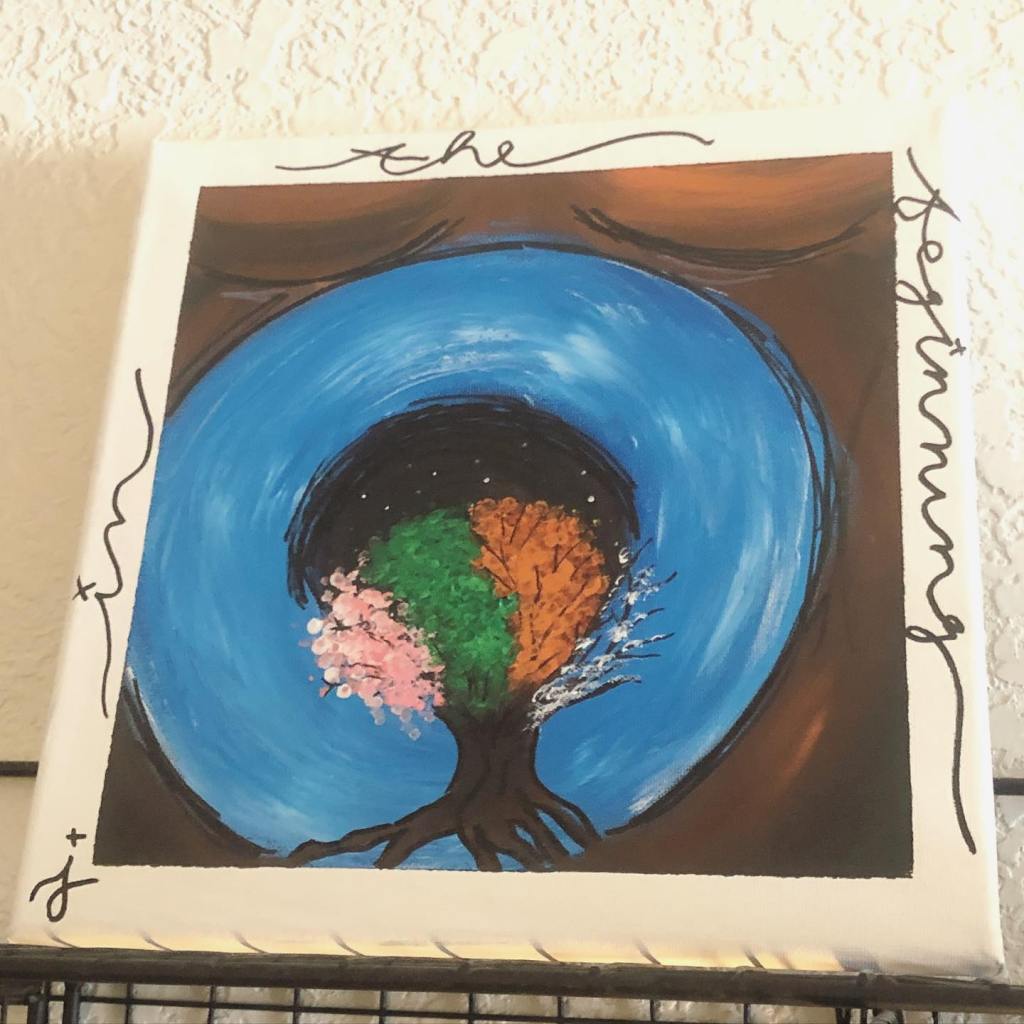
Lent has long been my favorite season of the liturgical year. I adore the practice of stepping into a spiritual liminal space of wilderness, where I can practice laying down, letting go, and taking up. For us in the northern hemisphere, Lent coincides with late winter, when all of creation is looking forward to the potential of spring. Looking out my window at the snow blanketed woods behind my house, I imagine the lives of the animals and plants tucked into the ground, sleeping and waiting. The deer family in their fuzzy winter coats come out at midday to stretch and look for some vegetation that may yet be found buried in the snow before they tuck back away for the long, cold night. The snow is the outer layer of a womb, hiding the genesis that is happening unseen. This late winter is my first time attempting to start plants from seed. I delighted in how incredibly tiny my spearmint and lavender seeds are. I tucked them into the rich, dark soil, imaging how that mysterious, unseen space will be their womb as they start their journey towards the light. This journey is a natural part of the seasons of creation around us and in us as G-d breathed beings in whose bones stars blaze and galaxies spiral1.
This time a year ago, I was looking forward to Lent with the expectation of Easter on the horizon. Every fiber of my being knows to look towards the light. I remember how we prepared for the pandemic at first like it was a winter storm approaching, one we just needed to weather for a few days, maybe a week or two at the most. In the same way that I never think to question that the sun is going to rise tomorrow, it didn’t occur to me that Easter might not come. The news during Holy Week that we wouldn’t be able to gather for Maundy Thursday, for Good Friday, for the Easter vigil, for Easter morning was devastating. I love the liturgical practice of keeping the silence and refraining from speaking or singing “Alleluia” all of Lent, for that joyful beginning of Easter morning service when the officiant declares, “Christ is risen!” and we can declare after the long night of Lent, finally, “Christ is risen indeed! Alleluia! Amen!” Well, when I heard the news that Easter was basically cancelled, I broke my silence early. Not because I was feeling particularly joyful, in fact I was feeling the opposite of joy, but because I needed that word. So I cried through my playlist I hadn’t listened to since the beginning of Lent; all the comforting songs that I had to put on a shelf, I brought back early. To me, it was like humming the tune of I Know My Redeemer Lives in the darkness of a Good Friday service. It was my altar in the deep night. A deep night that has long lasted
As I contemplate this new Lenten season, it feels a lot like last Lent never ended and we’ve just been in one, long, Lent, but one where the wilderness is less like the life-giving liminal space that I love so much and more like Ezekiel’s valley of dry bones. Many years ago now I started the practice of adding something to my regular routine during Lent as a sort of inversion to the traditional taking away of something. As someone who has recovered from an eating disorder, I thought that it was important for me to be careful to not ritualize self-denial that I had once lived to the detriment of my body. In a similar spirit now, as we mark a year of things we’ve been forced to give up, I would invite anyone contemplating what to give up for Lent this year to consider not giving up but consider adding something life-giving in. Even though there is a very important and necessary reason for all of the things we’ve had to give up for the sake of public health, it’s still traumatic. Especially for those of us still learning how to name and work through trauma we’ve experienced, I think it’s extremely important that we approach Lenten observances this year with a measure of gentleness to not reinforce any trauma we are experiencing or working through.
This brings me to the idea of resilience. Our very presence is a testament to resilience: as G-d image-bearers, our bodies and lives echo the days and seasons and all the movements of the celestial bodies that we’re made of. The oxygen from evergreen forests fills our lungs and we exhale carbon dioxide as an offering back to the universe in thanks as we continue this simple but vital life process that is a testament to our interconnectedness to resilience. This practice of looking both inward and outward, connecting my individual experiences to that of the universe around me and teaching myself that I am part of and made of resilience has been a great comfort to me this past year.
Another comfort I’ve recently started practicing is either a morning or evening prayer guided by Celtic Benediction, Morning and Night Prayer, compiled by J Philip Newell. Even though I haven’t been as consistent as I would like, I’m trying to let myself grow into this new habit. In this spirit, for Lent this year I plan to be intentional in practicing regular contemplative prayer. My church first introduced this practice to me and I’ve delighted in learning more about it with resources from Kaitlin Curtice, Richard Rohr, and Madeleine L’Engle.
I’m looking forward to this Lenten season, not just for the Easter that I’m hoping for at the end, but for the time in the wilderness. It’s wild and unexpected here, the chaos of genesis. But there are campfires out here, tiny altars for us to see by as we revolve through the dark, life-giving night towards the luminous dawn.
May we be those altars for each-other, bearing witness to our resilience as G-d image-bearers. Peace and grace and mercy be with you.
Amen +
In addition to Newell’s book, these are the resources I’m planning to use this Lent:
- 1Circle of Grace, A Book of Blessings for the Seasons by Jan Richardson (the poem I referenced above is Blessing the Dust)
- The Cure for Sorrow, A Book of Blessings for Times of Grief by Jan Richardson
- A Thousand Mornings, by Mary Oliver
- The Peace of Wild Things, by Wendell Berry
- Women’s Uncommon Prayers, compiled by Elizabeth Rankin Geitz et. al.
- Celtic Daily Prayer, Book One: The Journey Begins and Book Two: Farther Up and Further In, by the Northumbria Community
- A Rhythm of Prayer, by Sarah Bessey
 evergreen vox